List AUSD into Euler Prime & Euler Yield Markets

Proposal to List AUSD as a Collateral and Borrowable Asset in Euler Prime & Euler Yield Markets

Summary

This proposal seeks community approval to list AUSD, Agora Finance’s fully-backed USD-pegged stablecoin, as a collateral and borrowable asset in both the Euler Prime and Euler Yield markets. Adding AUSD will provide users with more high-quality stablecoin options, expand collateral diversity, and enable new DeFi strategies within Euler.

Motivation & Context

AUSD is a fiat-backed USD stablecoin issued by Agora Finance and redeemable 1:1 for USD via Agora’s platform. It is designed with mechanics similar to USDC, maintaining its peg through fully-backed reserves and robust redemption mechanisms. AUSD is ERC-20 compliant, with no transfer restrictions.

The reserves backing AUSD are held in Agora Reserve Trust, a Delaware Statutory Trust.

Custody: Assets are held with State Street, one of the world’s largest global custodians, which also acts as fund administrator.

Fund Management: The Agora Reserve Fund is managed by VanEck, a global asset manager with more than $130B in assets under management, investing primarily in overnight repurchase agreements, U.S. Treasury Bills, and cash.

This combination of regulated trust structure, institutional custody & professional fund management ensures institutional-grade security, transparency, and oversight.

Benefits to Euler Users

Collateral Diversity: Expands stablecoin options for lending, borrowing, and strategy building.

Capital Efficiency: Facilitates looping, hedging, and yield optimization strategies.

Institutional Trust: Attracts both retail and institutional users through regulated, transparent reserve management.

In Prime: Introduces a fully backed, institutionally managed stablecoin to Euler’s curated market, increasing user choice for stable collateral with deep liquidity and strong peg integrity.

In Yield: Enables AUSD & yield-bearing wrappers of AUSD to be used as collateral while accruing yield, supporting looping and leveraged yield strategies alongside other Prime/Yield assets.

Risk Parameters

We defer to Gauntlet to recommend reasonable risk parameters for AUSD in both Prime and Yield markets.

Oracles

AUSD pricing can be sourced from established decentralized oracle providers like Pyth referencing deep liquidity pools against USDC/USDT.

Liquidity Pools

AUSD/USDC (Uniswap V4)
AUSD/USDT (Uniswap V3)
AUSD/USDT (Balancer V2)

Security Considerations

Smart Contract Audits:
Agora Dollar EVM – Cantina & Spearbit (June 2024)
Agora Dollar EVM – Certora (July 2024)
Agora Dollar SUI – Zellic (August 2024)
Agora Dollar SUI – MoveBit (September 2024)

Reserve Attestations: Monthly management reports independently verify reserve composition and backing.
Full Archive

Important Links

Website
Documentation
Audit Reports
Attestations
Contract Deployments
Ticker: AUSD
Contract Address: 0x00000000eFE302BEAA2b3e6e1b18d08D69a9012a

Next Steps

Upon approval, Gauntlet will run its risk modeling and finalize parameters for AUSD’s inclusion in both markets.
1 Like

[Gauntlet] Integrate AUSD to Euler Yield

Summary

Should the community choose to onboard AUSD to Euler Yield, Gauntlet recommends the following:

Market Supply Cap Borrow Cap
Yield 2M 1.8M
Market Asset Base Rate Kink (%) Rate @ Kink Rate @ 100% (Max)
Yield AUSD 5% 90% 10% 20%

LLTVs are recommended to be kept similar to USDe on Euler Yield

Liquidity

On Avalanche and Katana, AUSD has established decent market traction, with a supply of 3M to 5M, highlighting organic user demand.

While mainnet liquidity remains limited (~$850K AUSD), this is mitigated by the fact that instant redemption mechanisms from AUSD to USDC/USDT are still under development, and additional liquidity expansion is expected once redemptions are live.

Given these dynamics, Gauntlet recommends an initial supply cap of 2 million AUSD with a borrow cap of 1.8 million.

Interest Rate Model (IRM)

We recommend aligning the AUSD IRM on Euler Yield with the parameters used for other Tier 2 stables, balancing borrow demand capture with appropriate risk controls:

  • Base Rate: 5%
  • Kink: 90%
  • Rate @ Kink: 10%
  • Rate @ 100%: 20%

This profile ensures healthy utilization without exposing lenders to outsized tail risk.

Loan-to-Value (LLTV)

Consistent with benchmarking against other stablecoins, Gauntlet recommends setting the LLTV for AUSD similar to that of USDe on Euler Yield. This ensures parity across stable collateral types and maintains collateral risk in line with market precedent.

underlying_symbol collateral_underlying_symbol lltv borrow_ltv
USDtb AUSD 90% 88%
PYUSD AUSD 90% 88%
RLUSD AUSD 90% 88%
USDT AUSD 90% 88%
wM AUSD 90% 88%
USDC AUSD 90% 88%
rUSD AUSD 90% 88%
AUSD sUSDe 90% 88%
AUSD syrupUSDC 92% 90%
AUSD PYUSD 93% 91%
AUSD USDC 93% 91%
AUSD USDT 93% 91%
AUSD wM 93% 91%
AUSD eUSDe 94% 93%
AUSD RLUSD 95% 93%
AUSD USDC 95% 93%
AUSD USDT 95% 93%
AUSD USDtb 95% 93%
AUSD sBUIDL 95% 93%
AUSD USDe 90% 88%
USDe AUSD 90% 88%

Next Steps

  • We welcome community feedback.
1 Like

[Objective] Integrate AUSD to Euler Yield

Summary

Objective Labs recommends listing Agora USD (AUSD) on Euler Yield as both a collateral and borrowable asset. USD’s DEX liquidity on Ethereum is very low, leading to a conservative recommendation for initial parameters. This integration will allow users to lend and borrow AUSD in fixed-yield markets, and allow for EulerSwap instances to expand AUSD’s footprint on Ethereum.

Fundamentals

Agora USD (AUSD) is an institutional-grade stablecoin issued by Agora, partnering with VanEck and State Street. It is fully backed by high-quality reserves including U.S. Treasury bills and cash-equivalent assets. AUSD is designed to maintain a 1:1 peg to the U.S. dollar and is redeemable directly with Agora by qualified participants. The token operates under a transparent issuance and redemption framework with regular attestation reports.

While AUSD is redeemable 1:1 with Agora, the standard redemption path requires institutional onboarding and sending tokens to a designated address for USD settlement, which is not instantaneous. Agora’s “Instant Liquidity” program enables 24/7 conversion of AUSD into other major stablecoins like USDC or USDT, providing faster exit options without banking-hour constraints — but this capability must be prearranged with Agora. Without that setup, liquidation speed is limited to the standard redemption process, which may introduce delays if AUSD needs to be quickly unwound as collateral. This setup consideration is important for collateral use, as redemption speed directly impacts liquidation efficiency during stress events.

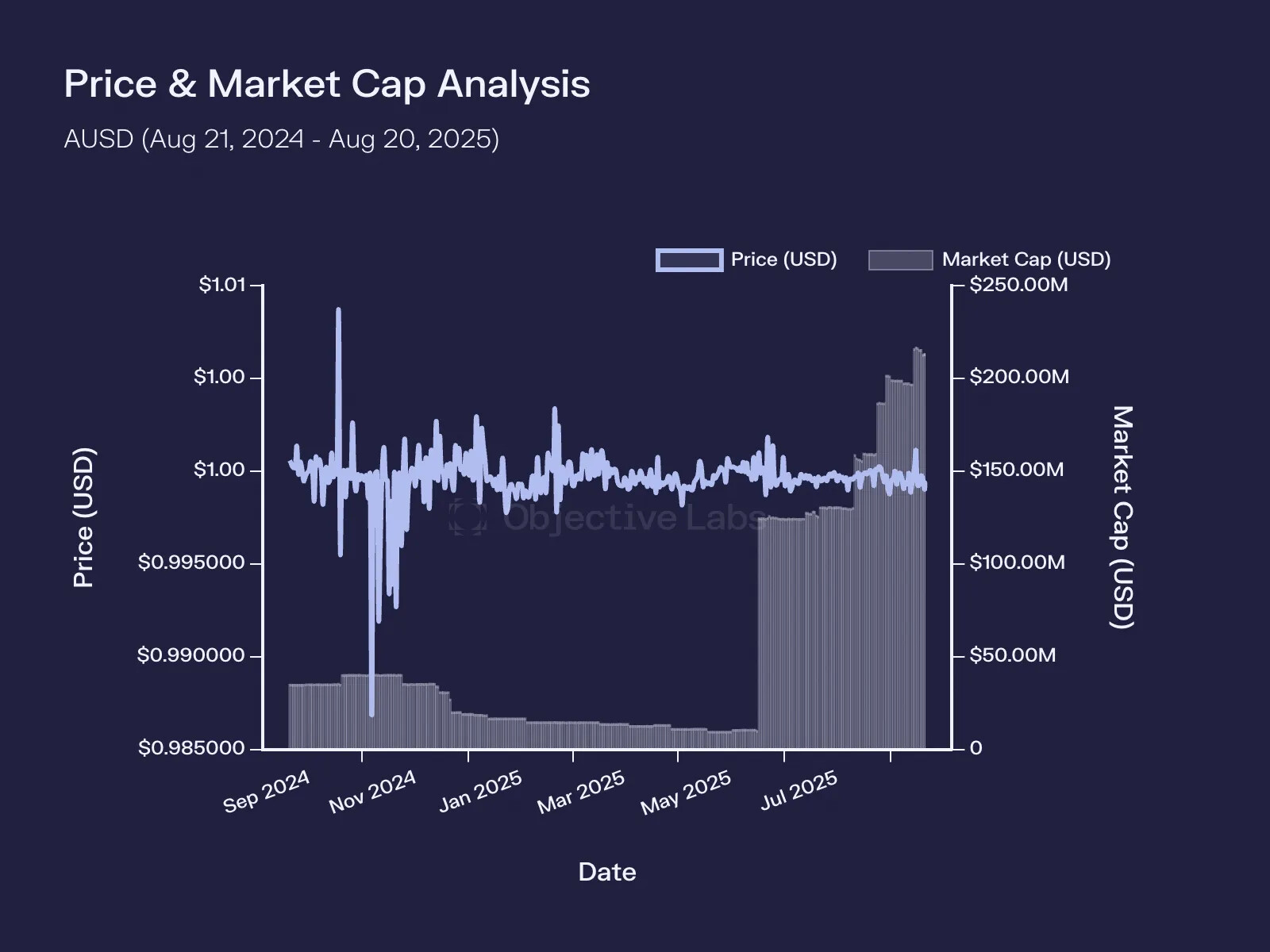
AUSD’s supply chart reveals significant step-wise supply expansion starting mid-June 2025, attributable to Agora’s $50M Series A (announced July 10). Holder analysis reveals an institutional-first strategy over retail distribution with less than 20% of supply on Ethereum attributable to retail holders. By contrast, Agora’s distribution on Katana is retail-first, leading to a reasonable hypothesis that this onboarding, paired with EulerSwap, may significantly expand Agora’s retail distribution on Ethereum.

Liquidity

AUSD’s DEX liquidity on Ethereum is very low with a $196k swap incurring 10% slippage. Due to this, we recommend conservative parameters for the initial onboarding. Contingent on instant swap/redemption capacity, these parameters may be adjusted at a later date.

Parameters

At this time we recommend an initial integration on Euler Yield only.

Caps

Asset Supply Cap Borrow Cap
AUSD 1M 900k
Market Asset Base Rate Kink (%) Rate @ Kink Rate @ 100% (Max)
Euler Yield AUSD 5% 90% 10% 15%

LTVS

Collateral Debt LLTV
AUSD USDC 92%
AUSD USDT 92%
AUSD PYUSD 92%
AUSD RLUSD 92%
AUSD wM 92%
AUSD USDe 92%
AUSD USDtb 92%
AUSD rUSD 92%
USDC AUSD 92%
USDT AUSD 92%
PYUSD AUSD 90%
RLUSD AUSD 92%
wM AUSD 90%
USD0++ AUSD 87%
USDe AUSD 87%
sUSDe AUSD 87%
eUSDe AUSD 85%
USDtb AUSD 92%
syrupUSDC AUSD 89%
PT-cUSDO-20NOV2025 AUSD 85%
PT-USDe-25SEP2025 AUSD 87%
PT-sUSDe-25SEP2025 AUSD 85%
PT-tUSDe-25SEP2025 AUSD 84%
PT-pUSDe-16OCT2025 AUSD 84%

Oracle

We recommend the use of a fixed 1:1 oracle to USD.

1 Like