[Objective Labs] Oracle Policy for Euler DAO Markets

Summary

This post proposes a unified oracle policy across Euler DAO-governed markets to improve liquidation fairness, reduce desynchronization risk across derivative-underlying pairs, and standardize provider choices by asset class and market behavior. The Oct 10 market stress event provided clear evidence regarding provider behavior and update cadence that informs these recommendations.

Policy

1. Derivative-underlying pairs: use coincidental price feeds

Within a given market, derivatives and their underlying assets must share the same price feed for the common underlying component.

Example
PT-pUSDe and USDe both read the same USDe/USD oracle.

Rationale
Eliminates oracle desynchronization between derivative and underlying legs, reducing liquidation unfairness during fast markets. Prior Euler guidance already stressed migrating entire asset families to the same underlying feed to avoid desync. See Modify Euler Yield's configuration to facilitate EulerSwap pools

2. Market price feeds for correlated pairs: prefer RedStone over Chainlink

For correlated assets with lower liquidity or cross-chain exposure, prioritize RedStone oracle feeds over Chainlink to reduce stale-quote risk during volatility.

Example
Prefer RedStone USDe/USD rather than Chainlink USDe/USD.

Rationale
Chainlink’s VWAP methodology and deviation-based push updates can underperform on thin or low-correlation asset pairs, creating transient mispricings and wrongful liquidations (e.g., the deUSD event on Avalanche). For correlated assets with lower liquidity or venue dispersion, RedStone’s tighter deviation thresholds (0.2% vs 0.5%) and faster update cadence reduce stale-quote risk. During the Oct 10 stress event, RedStone delivered faster, more granular price updates.

3. Major volatile pairs: use OEV-enabled price feeds

Pilot RedStone Atom for ETH/USD and BTC/USD.

Rationale
OEV aligns update rights with value capture during liquidations, increasing update frequency and reducing stale prices at the margin. Prior Euler research noted that granularity limits of deviation-threshold updates degrade Dutch auction efficiency. OEV-integrated updates can bypass thresholds and unify the price and blockspace auctions to reduce leakage and improve liquidation fairness. Both Chainlink (via SVR) and RedStone (via Atom) made faster, more granular updates with OEV enabled during recent stress periods.

ETH/USD and BTC/USD are the logical starting points: these are the most popular oracle feeds across DeFi, ensuring the largest and most competitive searcher networks will actively participate in OEV auctions. Additionally, we expect the majority of liquidations on Euler to flow through ETH- and BTC-denominated collateral pairs, making these feeds the optimal risk-reward choice for piloting OEV integration. Our independent evaluation of Chainlink and RedStone OEV solutions concluded that RedStone Atom’s architecture offers marginal advantages over Chainlink SVR in latency and granularity, although Chainlink’s solution benefits from greater battle-testing through its Aave integration.

4. Fundamental feeds: prefer onchain rate over oracle provider

For exchange-rate and fundamental assets (LSTs, ERC-4626 vaults, rate providers), use onchain rate functions rather than externally-sourced price feeds.

Example
weETH uses EtherFi’s onchain fundamental weETH/ETH rate rather than an oracle-provided weETH/ETH. ERC-4626 vault shares use the vault’s convertToAssets() method where manipulation-resistant.

Rationale
Onchain rate functions eliminate congestion-induced push/pull latency and reduce unnecessary transport-layer risk. For assets with direct, manipulation-resistant onchain redemption or exchange rates, querying the source protocol is more reliable than introducing an external oracle intermediary.

5. Pendle PT feeds: prefer custom/hybrid oracle over pure TWAP

For Pendle Principal Tokens (PTs) and similar derivative structures, prefer custom oracles engineered for these assets rather than a pure market TWAP.

Rationale
Pendle’s AMM has a built-in trading range that enforces a minimum PT price floor. During market stress, when traders dump PT positions, the implied APY spikes (as PT price drops). In this scenario, the PT can trade below the AMM’s minimum price on external orderbook venues while the AMM itself remains pinned at the floor. A pure TWAP oracle observing only the Pendle pool would overprice the PT relative to its true market value, creating liquidation risk for borrowers and bad debt exposure for lenders. Custom oracles that account for this failure mode, such as hybrid PT feeds, can avoid this pricing gap during crashes.
1 Like

Gauntlet supports Objective Labs’ proposed unified oracle policy and agrees with the outlined recommendations. The October 10 market stress event provided clear empirical evidence of how desynchronized feeds and stale-quote propagation can amplify liquidation risk across derivative-underlying pairs. We view this policy as a meaningful step toward standardizing oracle behaviour, reducing mispricing risk, and improving the fairness of the liquidation system-wide.

1 Like

Hi everyone, Raoul from Chainlink Labs here.

Thanks to Objective Labs and the Euler community for putting together a thoughtful framework on how Euler could consume pricing data across spot-like assets, PT/structured assets, and onchain rate sources. A number of the principles in the post are broadly aligned with how Chainlink already supports other large lending protocols, especially around:

  • Using onchain, deterministic rate sources when those are the authoritative reference;

  • Keeping derivative / PT-style assets tied to the same underlying reference to avoid desyncs; and

  • Being open to custom / hybrid pricing configurations for assets like Pendle PTs, stable-like assets, and cross-venue collateral.

If the DAO wants to explore those, we’d be happy to collaborate on Chainlink-powered, Euler-specific feeds that implement the methodology the community agrees on.

Below is some additional context on two areas of the proposal and to flag to @Gauntlet to surface our analysis.

1. Market price feeds for correlated or thinner markets

Objective Labs claims that, during the October 10th stress event, Redstone delivered faster and more granular price updates for pairs and suggests changing to Redstone on those smaller markets.

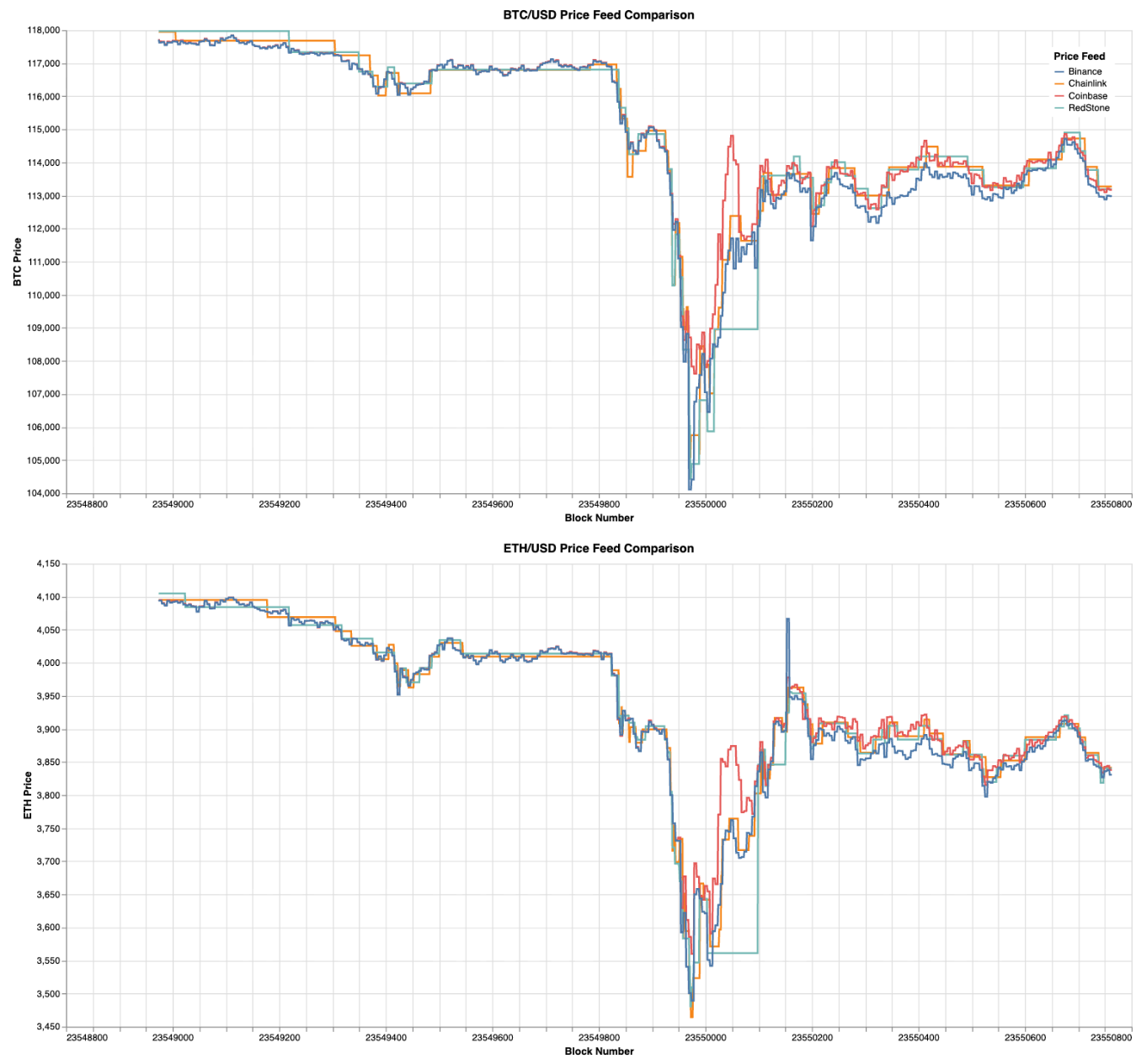
We ran an onchain comparison of the BTC/USD and ETH/USD price feeds provided by Chainlink and RedStone on Ethereum mainnet during the Oct 10 volatility window, using Binance and Coinbase as benchmarks. In that window:

  • Chainlink updates continued to track the leading CEX markets through the largest part of the move, even as gas fees spiked to well above 300 GWEI.

  • RedStone stopped publishing onchain updates entirely for more than 100 blocks (~20 minutes) during the most volatile period, which was exactly when timely oracle updates were needed the most. Please see the charts shared below for a timeseries.

That is precisely the scenario lending markets try to defend against: the market is moving up rapidly and the oracle is flat.

Some of the largest oracle-related losses in lending have come from situations where an oracle was misrepresenting the market price because the feed lagged. A clear example is Compound’s UNI incident. The protocol rejected the price from the Chainlink UNI/USD feed in favor of a slower moving Uniswap TWAP. An attacker flashloaned and borrowed at that lower oracle price and sold at the real market price; the protocol was left with bad debt. That type of issue can occur any time an oracle falls behind real markets, including during an outage like the one above.

If the concern is to get more responsive behavior on Euler’s specific assets, we can address that within Chainlink:

  • Chainlink oracles are highly configurable and modular, tighter deviation thresholds can be set to facilitate higher onchain update frequencies;

  • Chainlink oracles can support any data aggregation or pricing methodology desired by users. In addition to volume-weighted average (VWAP) trade pricing, Chainlink also supports liquidity-weighted bid/ask (LWBA) pricing and State Pricing. Chainlink State Pricing is optimized for long-tail crypto assets and wrapped/tokenized assets that predominantly trade on decentralized exchanges (DEXs), providing best-in-class accuracy for assets that have limited trading volume on CEXs but notable onchain liquidity; and

  • Chainlink can support regime-aware custom configurations for stable/pseudo-stable assets built in collaboration with Euler.

With Chainlink, Euler can obtain the behavior desired by price oracles, while maintaining liquidation-critical markets on established oracle infrastructure that continue to publish reliably onchain during the Oct 10 stress period.

2. On OEV / liquidations

The proposal also recommends piloting RedStone ATOM on the main markets for atomic liquidations and OEV capture.

For consideration, we believe the DAO should be aware of a few operational points:

  1. Maturity and TVL
    ATOM is relatively new and, to our knowledge, has not yet secured meaningful TVL during a high volatility event on Ethereum mainnet. By contrast, Chainlink SVR has been live on Aave v3 Ethereum for over six months, with the latest expansion seeing SVR now cover ~75% of Aave’s total Ethereum TVS, which represents ~95% of Aave’s OEV-relevant TVS. SVR has processed over $110 million in liquidations, and has already recaptured more than $3.5 million in liquidation MEV and routed more than $2 million value back to the Aave DAO.

  2. Dependency on an oracle that paused
    ATOM ultimately depends on RedStone feeds continuing to update reliably. On Oct 10, as highlighted above, RedStone feeds for major assets did not update for 100+ blocks during the most volatile part of the move. If prices had continued to fall, any protocol building on those prices would have been exposed. This presents a reliability risk to the protocol as price feed reliability is intrinsically tied to the OEV recapture solution used .

  3. Execution / gas profile of the current FastLane / Atlas flow
    The current design introduces notable overhead:

    • The auction management contracts add gas on every call;

    • And Atlas settles all bids onchain, which means every bidder’s calldata is included in the bundle, not just the winner’s.

In practice, during volatility this design could lead to:

  • Searchers eventually reducing participation because losing an auction still costs gas;

  • Very large bundles that are harder to include when gas is already high (the exact moment you need liquidations); and

  • An attack surface where a single bidder can update the oracle, make the liquidation fail, and then liquidate through the public path without sharing OEV.

By comparison, since Chainlink SVR launched in production earlier this year, the average OEV recapture rate has increased 3x (~20% to ~70%) while the total value secured grew 100x (~$400M to ~$40B+). SVR markets have processed over 824 liquidations in 6 months that paid out ~$5.2M in liquidation bonuses. In parallel, the number of independent searchers on SVR has continued to increase to beyond 40, helping increase SVR’s decentralization and supporting a healthy, competitive searcher market. In working closely with the Chainlink user base, we have gained valuable experience and in-production data that helps us continuously improve the performance of SVR.

Public metrics for SVR’s Aave implementation as tracked by Llamarisk Source

Given that, a practical approach would be for Euler to use Chainlink SVR feeds for the main markets now, and perhaps explore newer Chainlink-powered OEV designs on smaller or less critical assets on chains with less gas sensitivity.

Chainlink x Euler alignment

  • We agree Euler should be able to list Pendle PTs and other structured assets on top of oracles that actually understand those assets. We can spin up custom/hybrid feeds for those together.

  • We agree that fundamental/on-chain rate sources (where they’re clearly authoritative) can be consumed directly, without using an oracle to restate the rates.

  • We agree it can be useful to have regime-aware configurations for stables and stable-like assets so you get a “1.00” UX in normal conditions and real-market pricing in depeg conditions.

We would be excited to collaborate with Objective Labs, Gauntlet and the Euler community to explore the creation of custom smart oracles, dive deeper into the design of SVR and how to adjust Chainlink’s modular oracle architecture to align with your needs.

1 Like
